
“With every deal that I work on, policy is always in my mind — safety for our seniors, our parents, our children. I’m always asking: is this somewhere that you would live? If the answer is no, then why are we doing this deal?”
Meet Christa Freeman: an Atlanta-based attorney who views social justice as a public responsibility, not a personal milestone.
The Spelman College alumna and Howard Law School graduate has built her career at the intersection of law and justice. In spaces where numbers and negotiation often dominate the conversation, Freeman focuses on people, especially those most affected by policy decisions they rarely help shape.
Even though her work includes municipal policy, affordable housing, public finance, politics, and much more, it all centers around one question: Who are we doing this for?
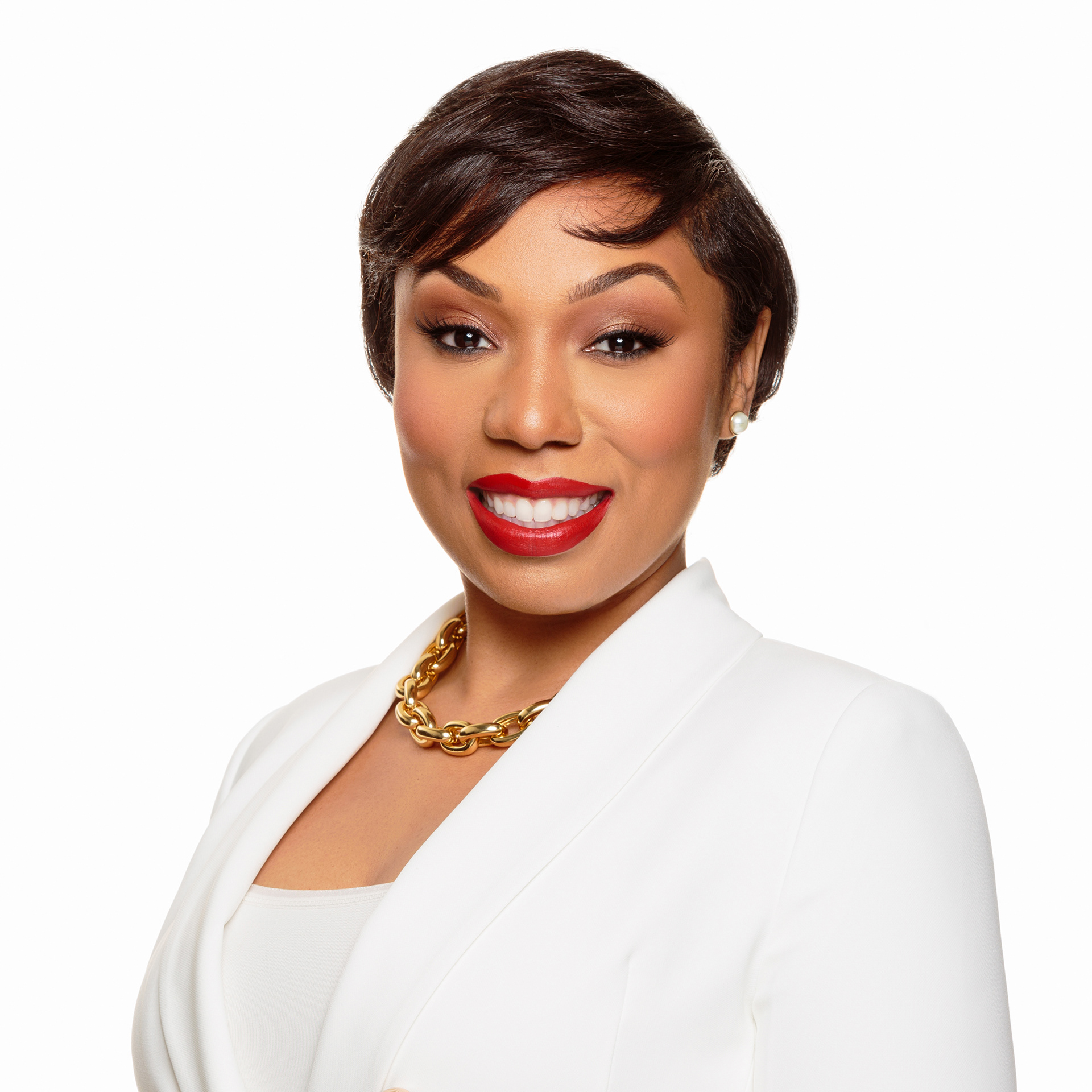
Photo/Courtesy Christa Freeman
Freeman's story begins in Augusta, Ga. Raised in a family that emphasized values like accountability, honesty, empathy, compassion and humor, her moral and social foundations are rooted in appreciation of people simply for who they are. Her commitment and diligence, combined with lessons from her grandparents, allowed her to find success in her primary education.
“My father’s father was an entrepreneur, and he believed that you had to work hard for every dollar and show respect to every person,” Freeman said. “On my mother’s side, my grandfather was a janitor and my grandmother was a beautician. From them, I learned how to get it out in the mud. But also, no matter how high you get, you still give respect to others. Respect is given to everybody.”
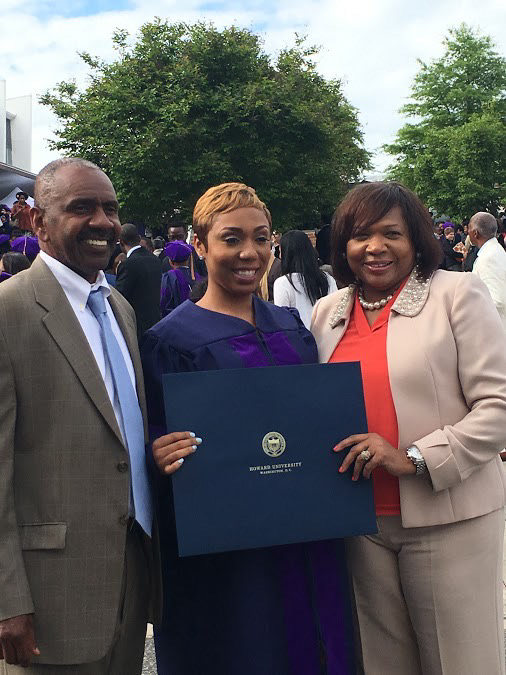
Freeman stands between her parents after graduating from Howard Law School. (Photo/Courtesy Christa Freeman)
Freeman enrolled in Spelman College in the fall of 2001. It was during her undergraduate years where she really began to understand the power of connection. Whether it was with her fellow Spelmanites, professors and alumnae willing to invest in her or other students in the Atlanta University Center, her potential grew as her relationship did.
"Spelman College built my largest network," Freeman said. "That network has carried me in ways I didn’t fully understand at the time."
After graduating from Spelman in 2005 and earning her Master's in Public Administration from Howard University, she returned to school a third time to earn her J.D.
“I went back to law school late—I started at 29," Freeman said. "I worked free internships, unpaid internships, and they turned into some of the biggest blessings in my life. Those opportunities led to the network I have today, to million-dollar bond deals, and to leadership roles I never imagined. I was never blinded by money. My passion always stayed in front of me, and I was always asking myself why I was doing the work and what I wanted to see come from it.”
Freeman’s path toward social justice work sharpened during graduate school, when she began encountering systemic harm not as theory, but as lived reality. While participating in an Alternative Spring Break program, she was assigned to work in Chicago with parents who had lost children to gun violence — an experience that reframed her understanding of policy, grief, and responsibility.
“I was introduced to parents who had lost their children to gun violence," Freeman said. "I heard the most horrific stories. I helped them with grant writing and setting up their 501(c)(3), and I’m still close with them to this day.”
Years later, the issue became deeply personal. In 2010, one of Freeman’s close friends was murdered, collapsing any remaining distance between advocacy and lived experience. What had once been community work became personal loss, reinforcing her belief that gun violence is not an isolated issue, but a systemic crisis.
“Gun violence is the cause closest to my heart," Freeman said. "In 2010, one of my close friends was murdered. In the African American community, gun violence is the number one killer of Black men. This is a public health epidemic.”
For Freeman, moral clarity must translate into policy. She does not frame reform in abstract language, but in concrete systems — tracing accountability through legislation, enforcement, and political power.
“If you are mentally ill, you should not be able to get a gun," Freeman said. We need to trace all guns and ammunition, wipe out the black market, and strengthen the ATF. The NRA needs to be wiped out — straight up — because they have Congress under control. That’s why legislation can’t make its way through.”
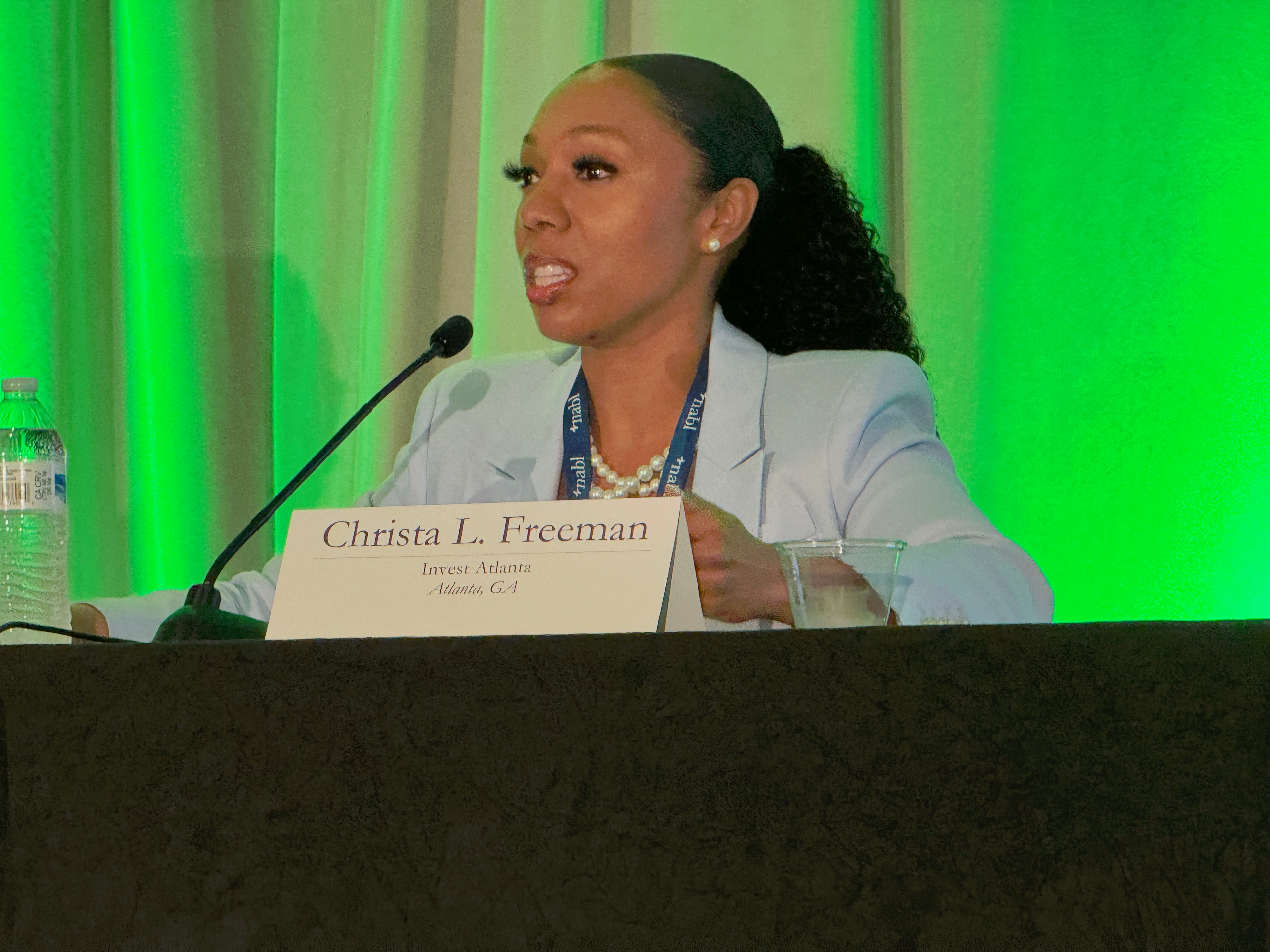
Freeman speaks out against gun violence a conference with fellow lawyers. (Photo/Courtesy Christa Freeman)
That same directness defines Freeman’s leadership style. In spaces often shaped by hierarchy and deference, she centers decisiveness, boundaries, and responsibility — especially as a woman navigating positions of authority.
“The ability to say no is the most powerful tool you have. As a woman in leadership, setting boundaries matters. You have to be decisive, analytical, and grounded. People listen to you, so you have to measure twice and cut once.”
But Freeman’s understanding of justice does not stop at policy advocacy or leadership theory. It is embedded in the everyday mechanics of her professional work — particularly in housing and development, where decisions made in boardrooms directly shape the lives of families, seniors, and children.
“I’m sister soldier all day long on these deals. People are making millions, the city is getting what it needs — but I’m always thinking about whether the people living there are safe and treated with dignity. I always ask, ‘Is this somewhere you would live?’ And if the answer is no, why are we doing this deal?”
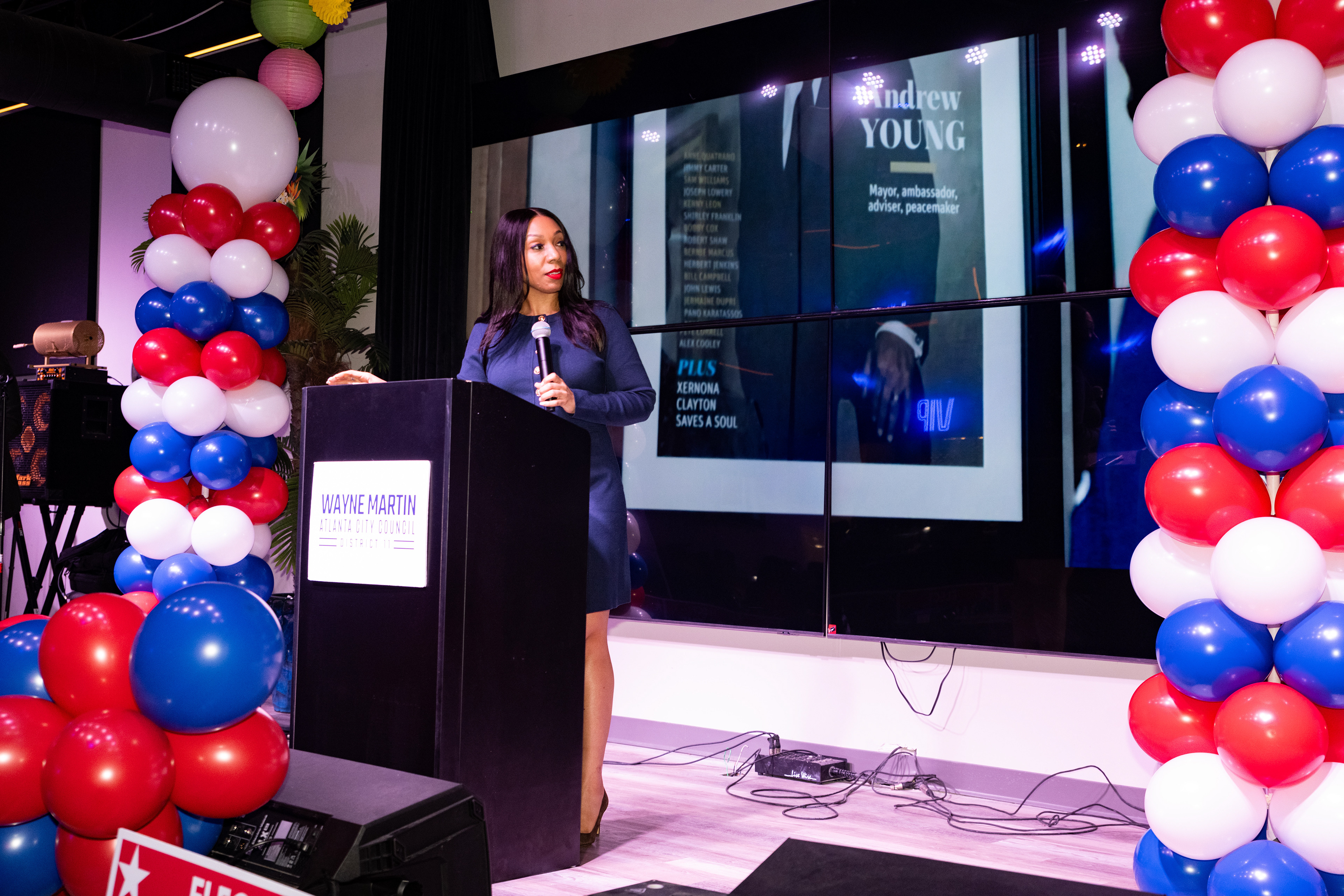
Freeman speaks at the victory party for Councilman Wayne Martin II. The two met in college, and she served as Finance Chair of his successful campaign for Atlanta City Council District 11. (Photo/Noah Cathey)
Her resistance to injustice is not fueled by ideology alone, but by empathy and identification. Freeman consistently frames her work through the lens of proximity — imagining herself in the positions of those most affected by policy outcomes.
“I do this because I want somebody to do it for me. I was blessed, but I know people who weren’t — family members, friends, entire communities. I’m always thinking about what it would mean if this were me.”
Looking forward, Freeman’s vision of social justice expands beyond individual policy fights into structural transformation — leadership, workforce development, and generational stability.
“I want to see Black men and women grow into leadership roles in corporate America. I want to see Black families flourish through workforce development. And I want to see the restoration of women’s rights — straight up.”
For Freeman, leadership is ultimately rooted in humility — not symbolic gestures, but everyday relationships and recognition of shared humanity.
“Remain humble. No matter where you go or what room you walk into, keep good relationships with everyone — the janitor, the paralegal, the mailman. They will help you in ways you don’t expect, and they’ll give you an edge that has nothing to do with ego.”
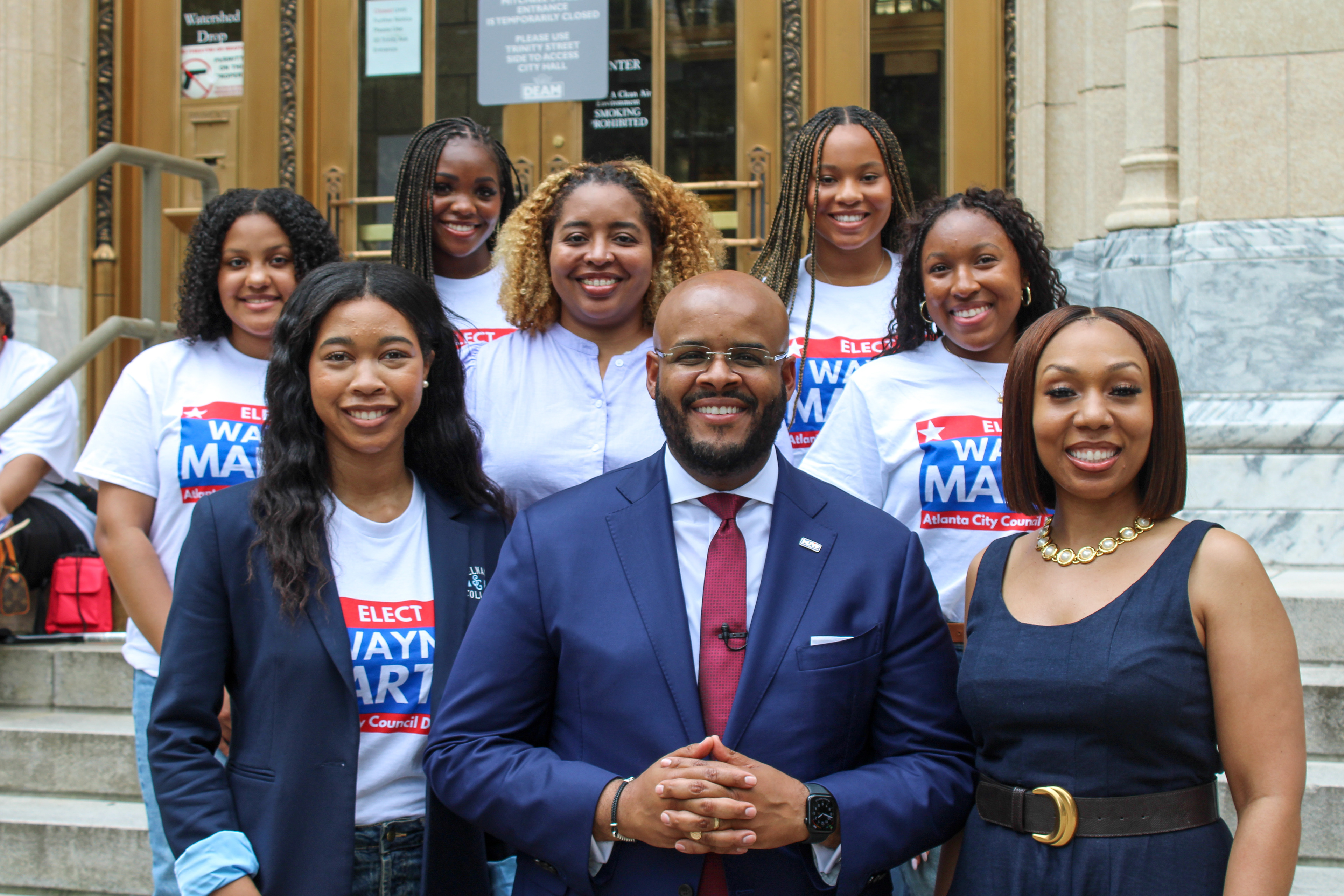
Freeman stands with Councilman Martin and a group of Spelman students she is mentoring in the realm of social justice and political advocacy. (Photo/Noah Cathey)
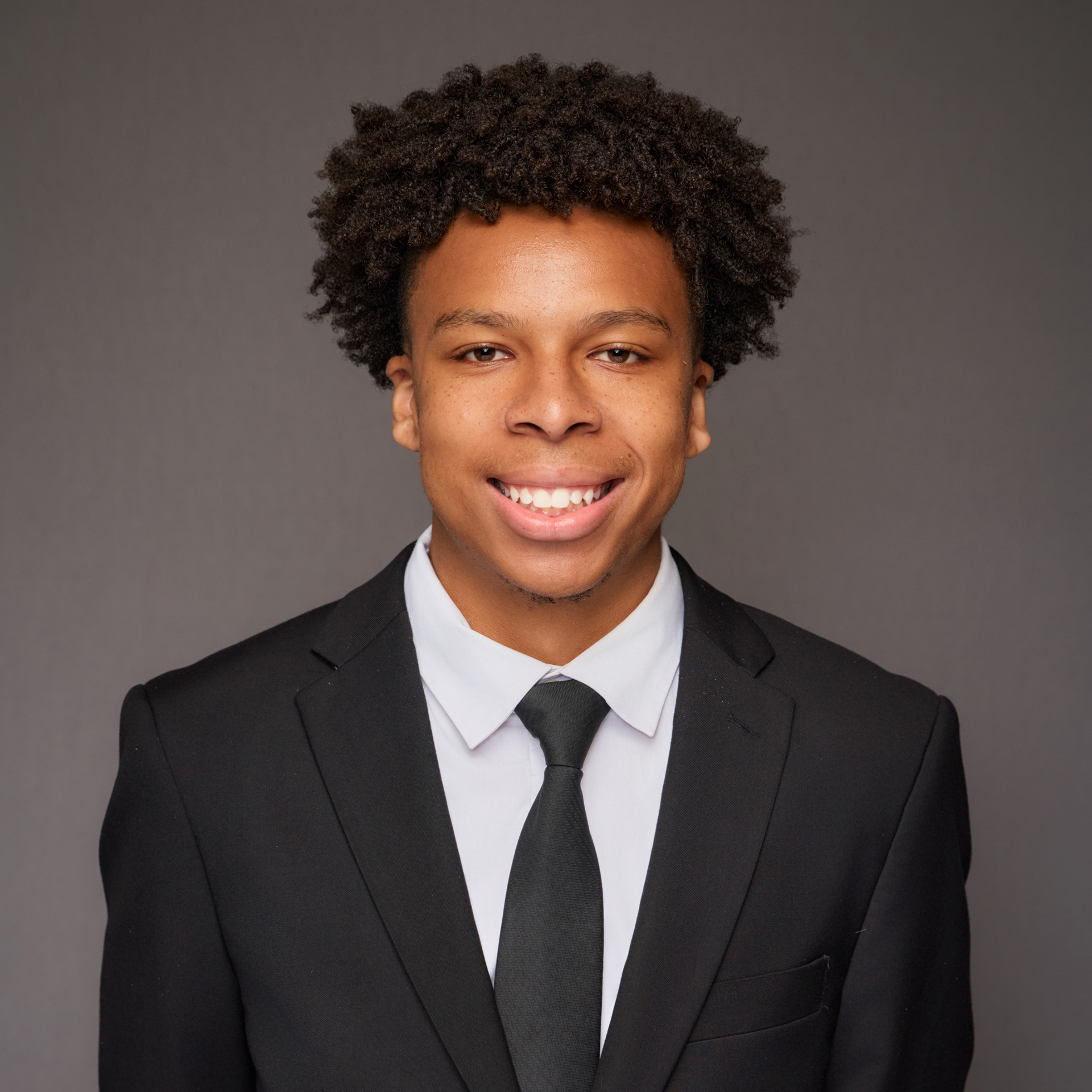
Noah Cathey is a sophomore journalism major attending Morehouse College. Cathey is a Dallas native who enjoys politics, hip-hop, basketball, photography, and poetry. With the aspirations of becoming an attorney, he desires to combine his storytelling skill and love of advocacy into a life of impact.